National platforms are trying to own the patient. trei gives you the infrastructure to keep them.
trei is a continuity program you deploy inside your own practice: your staff, your room, your patient relationship.
Discontinuation is common. Visibility into why usually isn't.
In a 125,474-patient U.S. cohort, 64.8% of GLP-1 initiators without type 2 diabetes and 46.5% with type 2 diabetes discontinued within one year. Moderate or severe gastrointestinal adverse events were associated with higher discontinuation. The practice often lacks a structured picture of what happened in between.
JAMA Network Open, 2025.
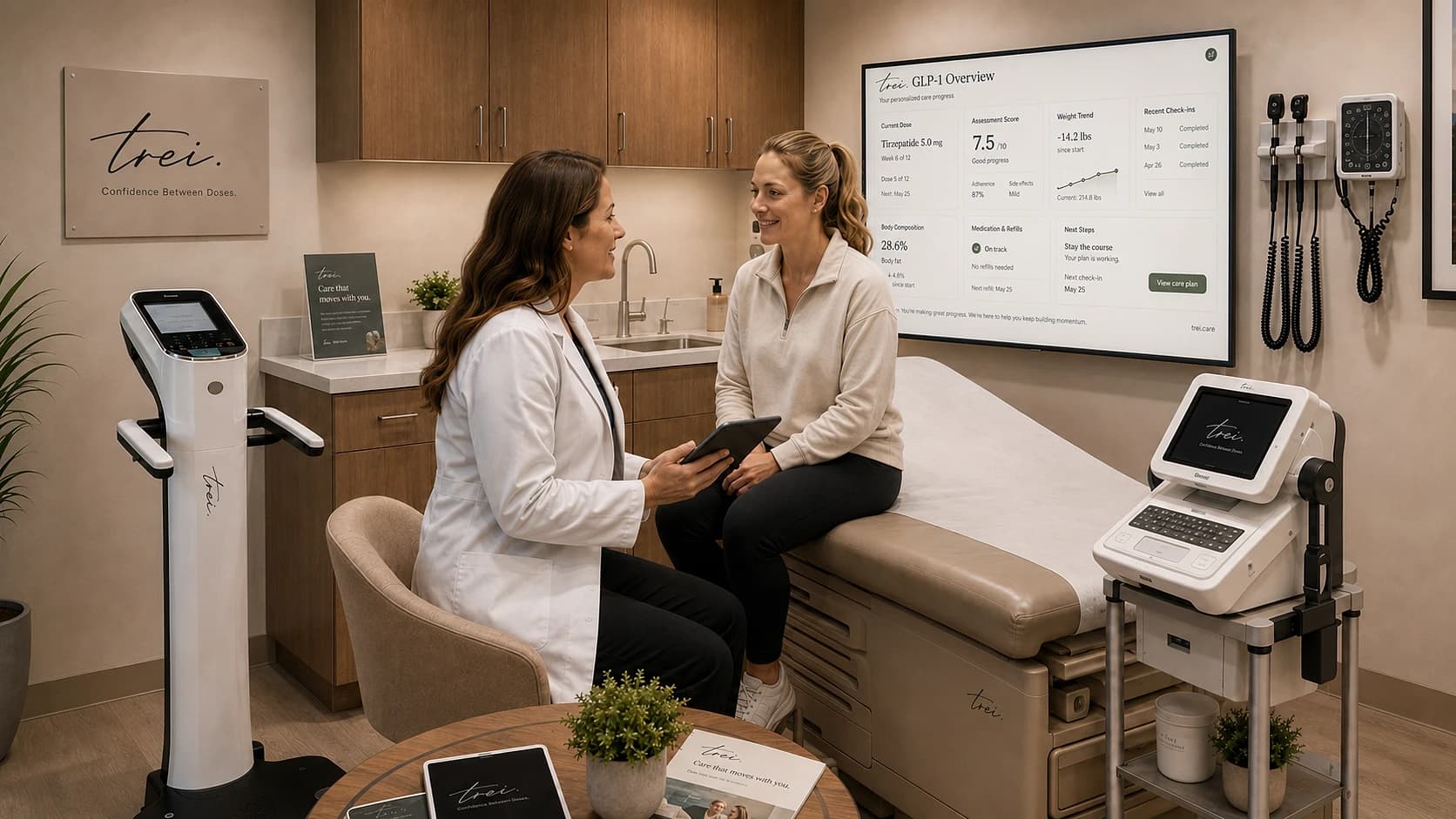
The ritual in the room is what gives the digital period meaning.
trei is built around a biometric protocol rather than a single machine, so the program can start inside the room and the workflow you already run.
Baseline matters
The first visit creates an objective starting point, not just a weight entry.
The return visit is a ritual
Measure, interpret together, connect it to the last treatment period, and set the next focus.
Device-compatible
The model is built around a biometric protocol, not dependence on one manufacturer.
Small-footprint deployment
The program can begin inside the practice's existing room and workflow.
What deploying trei actually looks like.
One room. Existing staff. A body-composition device you may already own.
Essential
An entry-level body-composition analyzer, a tablet, and a basic height and weight workflow.
Core
A mid-tier analyzer with segmental fat and water outputs. This is our preferred default for a dedicated metabolic practice.
Advanced
A higher-throughput device for a high-volume or research-oriented partner.
Existing equipment
Already have an approved body-composition device? Integrate it directly, for the lowest deployment friction.
What the program is worth to your practice.
trei is priced as infrastructure: a flat platform fee per location and a small fee per active participant. Nothing is tied to prescription volume, pharmacy referrals, or reimbursed services, so what the program earns you never depends on what you prescribe.
Annual practice contribution
Program revenue kept by the practice after the trei platform and participant fees, before staff time and hardware.
The assumptions behind the figures
- Program fee set by the practice
- $129 / participant / month
- trei platform license
- $995 / location / month
- trei active participant fee
- $12 / participant / month
| Active participants | Program revenue | trei cost | Practice contribution |
|---|---|---|---|
| 50 | $77,400 | $19,140 | $58,260 |
| 100 | $154,800 | $26,340 | $128,460 |
| 150 | $232,200 | $33,540 | $198,660 |
Illustrative model, under pilot validation. Figures assume a program fee set by the practice and exclude staff time and hardware. Your own pricing, payer mix, and panel will move these numbers. Nothing here is a projection of your results.
What trei charges
The Practitioner Alignment Covenant
This is a commercial commitment, not a marketing line.
- trei will not use your enrolled patients to build a competing GLP-1 prescribing service.
- trei will not sell prescriptions or medication to your patients.
- trei will not take prescription-volume or pharmacy-referral compensation.
- Your patient stays your patient.
Where trei is different.
- The patient relationship stays owned by the practice.
- Explicit, contractual non-prescribing alignment.
- In-office reassessment is part of the product, not an add-on.
- Trained practice staff, not a remote coaching army.
- Longitudinal context returned to the clinician who prescribed.
Three boundaries we build correctly from day one.
trei can capture, organize, educate, summarize, and surface information. It does not recommend a dose, diagnose an adverse event, or reassure a patient that a symptom is safe. When something crosses that line, the system hands the patient back to your practice.
trei is designed from inception for HIPAA business-associate relationships and BAAs, consistent with HHS guidance for apps acting on behalf of a covered provider.
A flat, documented program price, never a percentage of prescriptions, pharmacies, or reimbursed services. The model does not depend on Remote Patient Monitoring reimbursement either, and an in-office assessment alone is not equivalent to an RPM program.
Book a 20-minute walkthrough
We will walk through deployment, the biometric protocol, staff certification, and the covenant with your team.
Book a walkthrough