Built by people who have watched thousands of weight-loss journeys up close.
trei was founded inside a bariatric practice, where weight loss has never been treated as a single number, a single appointment, or a single intervention.
- 0+
- Years of bariatric practice behind the program
- 0+
- Bariatric procedures performed by the founding clinical team
- 0
- Beats in the loop the whole program is built on

Two decades of watching what happens outside the exam room.
For more than twenty years, the clinical team behind trei has worked with thousands of people across surgical and medical weight loss, helping patients navigate not only changes in weight but the behaviors, biometrics, symptoms, habits, and physiological changes that determine whether progress is actually sustainable.
That experience includes more than 5,500 bariatric procedures and years of longitudinal care before, during, and after major weight-loss interventions. It created a specific understanding of what happens between appointments: how nutrition, hydration, body composition, activity, adherence, side effects, recovery, and everyday behavior signal whether someone is progressing well, or beginning to drift.
Designed for what happens between visits.
GLP-1 medications have transformed weight-loss care, but the medication is only one part of the journey. The weeks between appointments are where patients make hundreds of small decisions, experience changes in their bodies, encounter side effects, build new habits, and sometimes begin to struggle without anyone noticing.
trei brings decades of bariatric experience into that space. By combining behavioral signals, meaningful biometrics, treatment context, and ongoing practitioner oversight, it creates a more continuous picture of each patient's progress. Rather than waiting for the next appointment to understand what happened, care can respond to what is happening along the way.
Lasting outcomes aren't determined by the dose alone. They're shaped by everything that happens between them.
Rooted in behavior and psychology, not only biometrics.
Two ideas from our research shape how the program is designed. Both are published in full at BariAccess.
Human connection is the missing 51%
Digital health programs lose people not because patients stop caring, but because the support is unattended. Guided programs consistently outperform unguided ones. When people feel supported, they stay in the process longer, and staying longer is what makes change likely.
Read the researchSmall changes, repeated, beat willpower
Automaticity builds over roughly two months of repetition in a stable context. Modest, specific targets survive real life in a way that dramatic overhauls do not. Success becomes less dependent on willpower and more dependent on an operational plan.
Read the research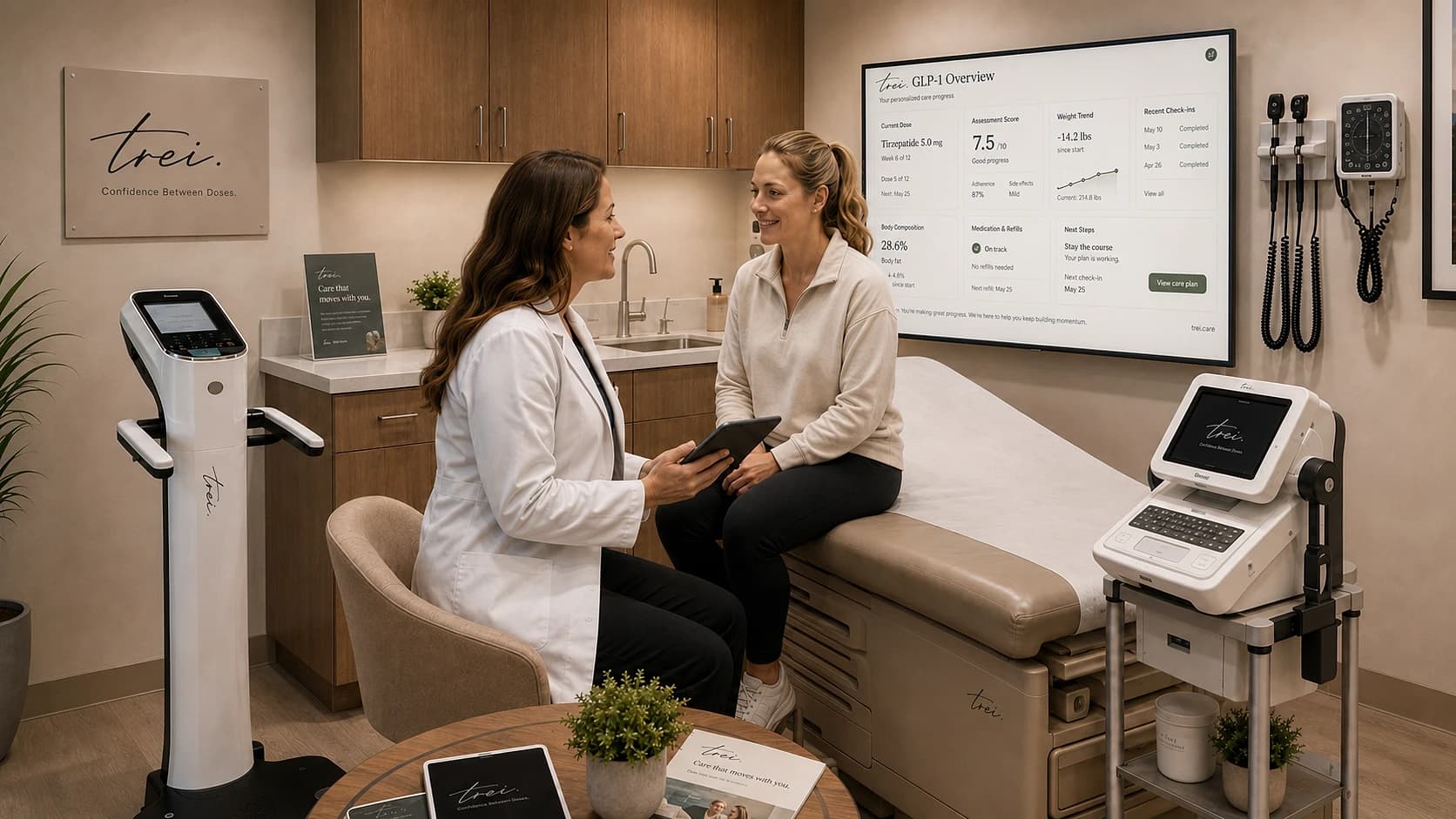
We measure rather than assume.
The evidence does not yet support claiming that any app solves GLP-1 adherence on its own, and we won't claim it does. What the evidence does establish is that discontinuation is common, and that the practice often lacks a structured picture of what happened between visits. That's the gap trei is built to close. Where the evidence isn't in yet, we say so.
The clinical anchor
trei is built alongside Bariatric Associates and operated by BariAccess, LLC.